

Vegetative Cultivation and Domestication
“A good, clean, vegetative and productive cultivar is the most valuable asset any land-based seaweed farm has.”
This statement from seaweed industry expert Jeff Hafting captures a central truth in modern seaweed cultivation: while engineering defines the system, biology defines its success.
At Pure Algae, we see this every day. Tanks, sensors and infrastructure can be optimized to a high degree, but without stable and high-performing biological material, even the most advanced setup will struggle to deliver consistent results.
The Biological Bottleneck in Seaweed Cultivation
For many commercially relevant species such as Ulva (sea lettuce) and Palmaria palmata (dulse), traditional cultivation relies on sexual reproduction. While this is a natural part of their life cycle, it introduces several operational challenges:
Strong seasonality constraints
Unpredictable spore release events
Slow and variable early-stage growth
Increased complexity in experimental design and scaling
These factors can limit productivity, delay scale-up and introduce unnecessary biological risk into both research and commercial operations.
A Shift Toward Vegetative Propagation
Vegetative propagation offers a fundamentally different approach.
By maintaining seaweed in a continuous vegetative growth phase under controlled conditions, it becomes possible to bypass reproductive cycles entirely. This removes many of the uncertainties associated with spore-based cultivation and enables a more stable and predictable production process.
The advantages are significant:
Consistent and predictable growth dynamics
Reduced dependency on seasonal triggers
Faster establishment and scaling
Simplified operational workflows
In practice, this means that cultivation can move from being reactive to controlled and from variable to reproducible.
From Biology to Production Reliability
At Pure Algae, we specialize in developing and maintaining high-performing vegetative cultivars tailored for land-based systems.
Our work focuses on:
Strain selection based on growth performance and target characteristics
Cleaning and decontamination to ensure axenic or low-contamination cultures
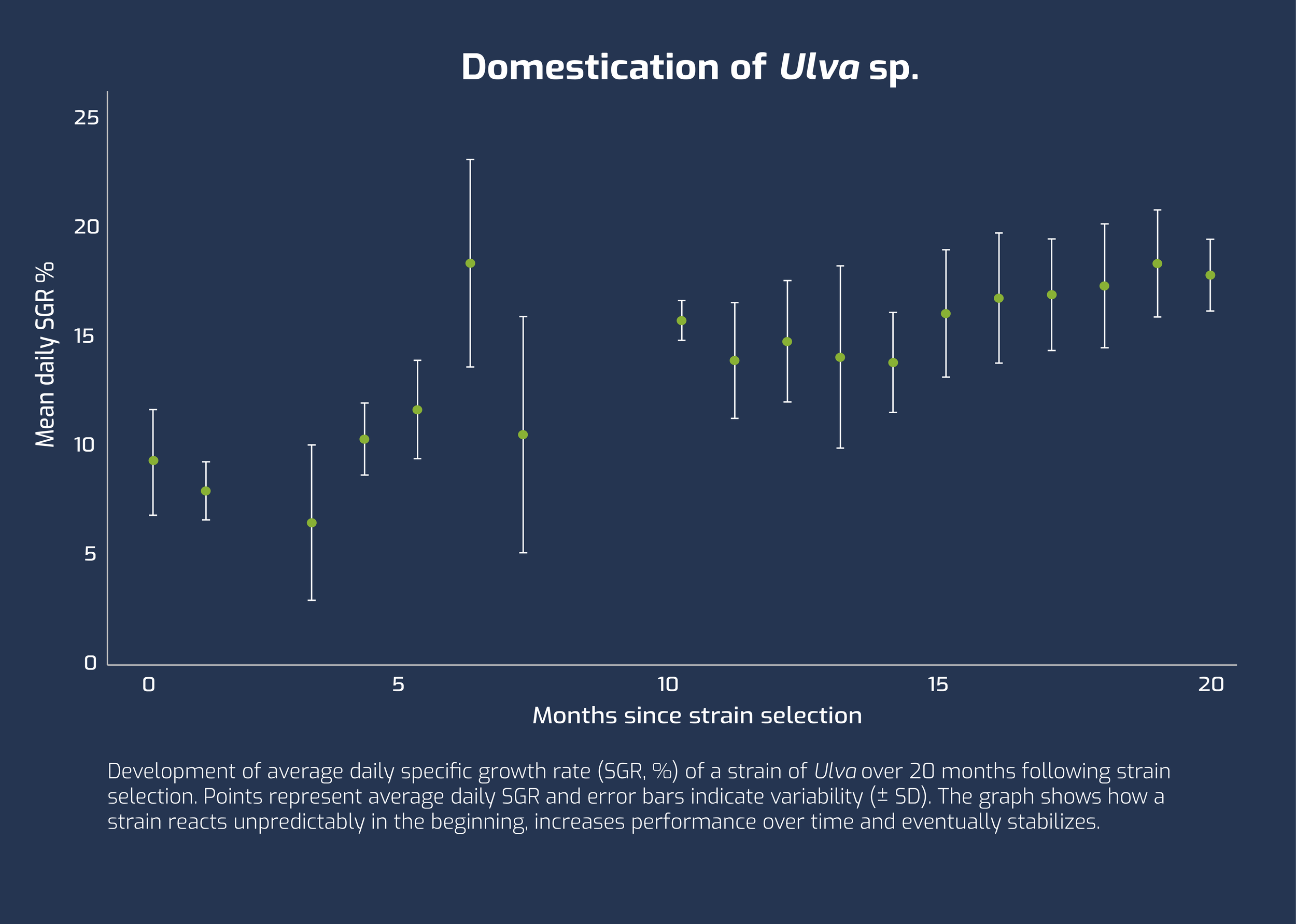
Stabilization of growth behavior under controlled conditions
Optimization of cultivation parameters before scale-up
Through this process, we reduce biological uncertainty early on, allowing our partners to enter pilot or commercial production with a significantly stronger foundation.
A Robust Ulva Cultivar - and Beyond
One example of this approach is our established Ulva strain, which has been developed for robustness, productivity and stability in controlled systems. This strain is available to partners seeking reliable starting material for research, pilot trials or full-scale production.
However, our collaboration model is not limited to in-house strains.
We also work with client-owned material, supporting the early and often demanding stages of:
Strain development
Stabilization
Domestication for controlled environments
By handling these phases within our laboratory setup, partners can avoid many of the typical challenges associated with reproductive propagation and early-stage instability.
Enabling Faster and More Reliable Scale-Up
The transition from lab to production is one of the most critical phases in seaweed cultivation. By ensuring that both biology and system are aligned from the beginning, it becomes possible to:
Shorten development timelines
Increase reproducibility across scales
Improve overall system performance
Align cultivation with specific scientific or commercial objectives
In this context, vegetative propagation is not just a biological alternative. It is a strategic tool for enabling reliable scale-up.
Bridging Research and Industry
Recent research, including work by Liboureau and Pampanin (2024), continues to demonstrate the potential of vegetative propagation in species such as Palmaria palmata. These findings support what we observe in applied systems: controlled vegetative growth can significantly improve both operational stability and production outcomes.
At Pure Algae, our focus is on translating this biological understanding into practical, scalable solutions.
Because in the end, successful seaweed cultivation is not just about growing biomass. It is about building a system where biology performs predictably, reliably and in alignment with your goals.
Source mentioned: Liboureau, P. & Pampanin, D. M. (2024) Study on vegetative propagation of Palmaria palmata, Food Chemistry, ScienceDirect.