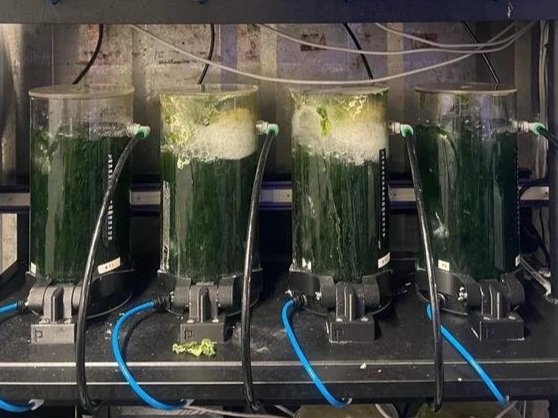
Flow Mode Increases Biomass Yield by 53% in Our Laboratory Setup
Recent trials in our Laboratory Setup have shown a clear difference between cultivation in batch and flow mode. Across the trials, flow mode resulted in a 53% higher biomass yield compared with batch mode, corresponding to an additional 6.5 g/L of biomass per week. Average biomass yield increased from 12.3 g/L in batch mode to 18.8 g/L in flow mode. We also observed a higher specific growth rate under flow conditions.
More than a difference in yield
The difference between the two cultivation modes was not limited to the measured biomass production.
It was also clearly visible in the cultures themselves.
During batch cultivation, the cultures gradually became more turbid and showed increased foam and particle build-up. Under flow conditions, the cultures remained visibly cleaner throughout the cultivation period.
These observations indicate that continuous water exchange may contribute to a cleaner cultivation environment while simultaneously supporting higher biomass production.
Higher productivity and cleaner cultivation conditions
For controlled seaweed cultivation, productivity is only one part of the equation. Maintaining stable cultivation conditions over time is equally important, particularly when moving towards repeatable experiments and reliable production.
Our results suggest that flow cultivation can provide advantages on both fronts: higher biomass yield and cleaner cultivation conditions.
The exact mechanisms behind the difference will depend on factors such as nutrient availability, water exchange, waste-product accumulation and cultivation density, and these are areas we continue to investigate.
One system, both cultivation modes
Importantly, choosing our Laboratory Setup does not mean choosing permanently between batch and flow cultivation.
The system is designed to operate in both modes and can easily be switched between them. This allows users to compare cultivation strategies, optimise conditions for different species and adapt the setup as research or production requirements change.
For laboratories working with seaweed cultivation, this flexibility makes it possible to test different approaches within the same controlled system — and identify the cultivation strategy that performs best for the specific application.